
The Silent EBITDA Killer: How ‘Decision Friction’ is Slowing Your Growth Cadence
Executive Summary
In the high-stakes environment of 2026, the primary differentiator between market leaders and also-rans isn't just capital: it’s Decision Velocity. "Decision Friction", the cumulative drag of bureaucratic layers, information asymmetry, and consensus-seeking culture, is a silent EBITDA killer. This post explores how operational friction erodes margins, why speed is a strategic moat, and how PE-backed firms and Fortune 1000 leaders can audit their decision-making processes to recover lost profitability. By shifting from "process-heavy" to "velocity-first" frameworks, organizations can turn decision-making into a competitive advantage.
The "Committee" Trap: When Speed Becomes a Luxury
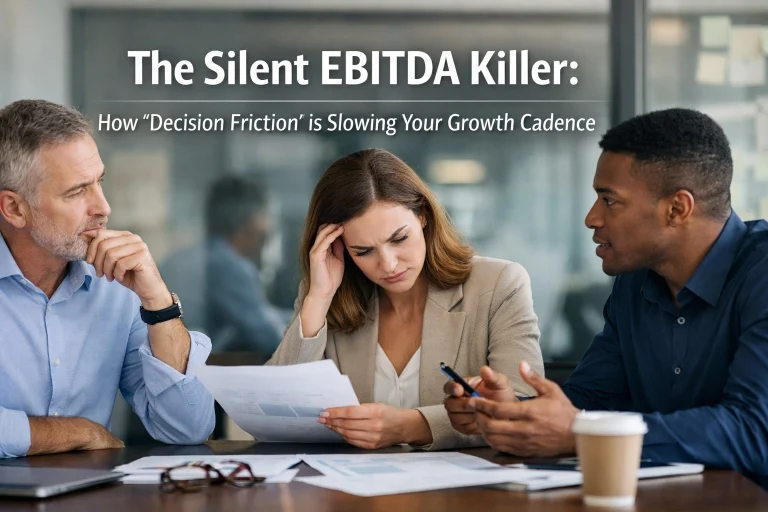
Imagine a Private Equity-backed mid-market firm. They’ve identified a strategic acquisition or a pivot in their supply chain strategy that could save millions. But before the "Go" signal is given, the proposal must pass through three sub-committees, two "alignment" meetings, and a final sign-off from a board that only meets once a month.
By the time the decision is made, the market has moved, the competitor has closed the gap, and the opportunity cost has bled into the income statement.
At RampUp Growth Advisors, we call this "Decision Friction". It is the resistance encountered within an organization that slows down the movement from data to insight, and from insight to action. In a world of volatile markets, the ability to move fast isn't just a "culture" thing: it’s a financial imperative.

Decision Velocity vs. Operational Friction
To fix the problem, we must first define the metrics.
- Decision Velocity: The speed at which an organization can identify a challenge or opportunity, process the relevant data, and commit to a course of action.
- Operational Friction: The structural, cultural, and technological "drag" that occurs between these steps.
High-velocity firms don't necessarily work harder; they work with less "drag." They understand that a 70% correct decision made today is often more valuable than a 90% correct decision made three weeks from now.
Why Decision Friction is an EBITDA Killer
Friction doesn't appear as a line item on your P&L, but it’s hidden in the margins. It erodes EBITDA in three specific ways:
- Direct Labor Cost: Every "alignment meeting" is a billable hour sink. If ten $200k/year executives sit in a room for two hours to "discuss" a decision that a mid-level manager could have made, that’s thousands of dollars of EBITDA literally evaporating.
- Opportunity Cost: The delay in launching a product or optimizing a pricing strategy means months of missed revenue.
- The "Maybe" Tax: Organizations that can't say "Yes" or "No" quickly end up with "Zombie Projects": initiatives that stay in limbo, consuming resources and focus without ever delivering ROI.

The Expert Framework: Type 1 vs. Type 2 Decisions
To eliminate friction, we look to the masters of scale. Jeff Bezos famously popularized the concept of Type 1 and Type 2 decisions:
- Type 1 Decisions (One-way doors): Irreversible or nearly irreversible decisions (e.g., selling the company, a massive capital expenditure). These require slow, methodical deliberation.
- Type 2 Decisions (Two-way doors): Reversible decisions (e.g., a new marketing campaign, a small software implementation). These should be made quickly by high-judgment individuals or small teams.
The "Silent EBITDA Killer" thrives when organizations treat every Type 2 decision as if it were a Type 1 decision. This leads to Decision Paralysis, where the fear of a minor mistake prevents the achievement of a major gain.
Identifying Your Friction Points: An Operational Audit
How do you know if your organization is suffering from friction? Look for these "red flags" in your growth cadence:
- Information Asymmetry: Do your managers have the financial visibility they need to make calls, or must they wait for a monthly report from Finance?
- The "Consensus" Fallacy: Is there a requirement that everyone must agree before moving forward? Consensus is often the enemy of leadership.
- The Search for "Perfect" Data: Are teams delaying decisions because they are waiting for "one more data point" that likely won't change the outcome?

Strategic Solutions: Greasing the Wheels of Growth
Removing friction requires a blend of strategy and technology. Here is how we help our clients at RampUp Growth Advisors:
1. Radical Decentralization
Push decision-making power as close to the "front line" as possible. If a decision is reversible (Type 2), the person closest to the data should make it. This requires clear guardrails: KPIs and cash flow targets: that ensure decentralized decisions align with the overall strategy.
2. The "Agentic" Lever
In 2026, technology is the ultimate friction-reducer. By implementing Agentic AI systems, firms can automate the "pre-decision" phase. These systems can autonomously gather data, run scenarios, and present the three most viable options to a human leader. This reduces the time spent on "data gathering" from days to seconds.
3. Establish a "Decision Log"
Track the time it takes from "Proposed" to "Actioned." By measuring your Decision Latency, you can identify which departments or layers of management are acting as bottlenecks.

The 2026 Competitive Advantage: Decision Velocity
In a market defined by volatility and rapid technological shifts, the winner isn't always the biggest player; it's the one who can iterate the fastest. High-velocity firms can test five pricing models in the time it takes a high-friction firm to approve one. They can pivot supply chains in response to geopolitical shifts while others are still waiting for a committee report.
Operational friction is a choice. You choose to have layers. You choose to have silos. And by making those choices, you are choosing to accept lower EBITDA.
How to Start Accelerating Your Cadence
If you suspect your growth is being throttled by internal friction, it's time for a systematic audit.
Common Friction-Reduction Checklist:
- Audit your meeting culture: If a meeting doesn't result in a decision or a clear action, cancel it.
- Unified Data Source: Ensure your CFO and CIO are aligned so that everyone is looking at the same "Source of Truth."
- Incentivize Speed: Reward managers who make high-quality, fast decisions: even if they occasionally have to "reverse the door."
At RampUp Growth Advisors, we specialize in identifying these invisible bottlenecks that drain enterprise value. Whether you are a PE firm looking to optimize a portfolio company or a Fortune 1000 leader aiming to regain agility, we provide the trusted advisors and frameworks necessary to turn your decision-making process into a high-octane growth engine.
Ready to stop the EBITDA leak?
Don't let another month of "alignment meetings" erode your margins. Contact RampUp Growth Advisors today to learn how we can help you increase your decision velocity and reclaim your competitive edge.
Tags: #EBITDA #DecisionVelocity #GrowthStrategy #RampUpGrowthAdvisors #OperationalEfficiency #PrivateEquity #StrategicFinance

Written by
Christian Liu
Related Articles

The Ivy League of Innovation: Transforming Universities into High-Velocity Startup Hubs in 2026
The next unicorn isn’t being built in a garage. It’s being built in a dorm...

Beyond the Session: Why Scaling a Coaching Empire in 2026 Requires a Strategic Finance Co-Pilot
You didn’t build your coaching practice to become a slave to it. Yet here you...

The Proven Framework for Building Resilient Growth in Uncertain Markets
Let’s be honest: if the last few years taught us anything, it’s that “business as...