
The Modern Farmer’s Growth Engine: Why Strategic Finance is Non-Negotiable in 2026

Quick Summary
Modern farming operations face unprecedented financial complexity in 2026: record-high operating loans averaging 30% larger than previous years, working capital constraints affecting 57% of crop farmers, and 10-15% of producers questioning business viability. Strategic finance: real-time profitability analysis, dynamic cash flow forecasting, and data-driven capital allocation: has evolved from “nice-to-have” to survival requirement. This guide explores why tax-centric accounting no longer serves growth-focused agribusiness, and how strategic finance unlocks precision agriculture ROI, optimizes ESG asset monetization, and positions farms for institutional capital.
The numbers don’t lie, and right now, they’re screaming.
U.S. farmers took out operating loans 30% larger than the previous year in 2025, driven by input cost inflation and elevated cattle prices. Yet only 43% of crop farmers report strong working capital positions. Most alarmingly, 10-15% of farm operators are in a “red zone,” actively questioning whether they can stay in business this year.
If you’re running a mid-to-large scale farming operation or managing PE-backed agribusiness assets, you already know: the old playbook is dead. Year-end tax reconciliation and backward-looking P&Ls won’t cut it when commodity prices swing 20% in a quarter and input decisions made in February determine October solvency.
Welcome to the era where strategic finance isn’t a luxury: it’s the growth engine that separates thriving operations from liquidation auctions.

How Does Strategic Finance Differ from Traditional Farm Accounting?
Traditional farm accounting exists primarily for tax compliance and historical record-keeping. It tells you what happened last season: often 6-9 months after harvest when financial decisions can no longer be altered.
Strategic finance operates in a fundamentally different paradigm:
Accounting looks backward. Strategic finance looks forward.
While your accountant calculates depreciation schedules and prepares Schedule F forms, strategic finance builds rolling 18-month cash flow projections that model scenarios: What happens to liquidity if corn drops to $4.20/bushel? How does a 15% reduction in nitrogen application impact both cost structure and yield assumptions? What’s the breakeven acreage for that new autonomous planter?
Accounting is farm-wide. Strategic finance is field-specific.
Generic farm-level profitability masks critical realities. Strategic finance demands field-level profit analysis: because your 80-acre river bottom field and your 120-acre hillside parcel have completely different cost structures, yield profiles, and capital requirements. Research from Purdue University’s Center for Commercial Agriculture confirms that in-season, field-level financial clarity is now mission-critical as input costs and market conditions shift weekly.

Accounting focuses on tax minimization. Strategic finance optimizes for value creation.
Tax accountants are paid to minimize your current-year liability. Strategic finance professionals are built to maximize enterprise value and operational flexibility: which sometimes means accepting higher near-term tax burdens to fund growth infrastructure or optimize exit readiness for PE liquidity events.
Among farmers expecting larger operating loans in 2026, 31% cited carryover of unpaid operating debt from the prior year as the primary driver: a metric that has exploded from just 5% in 2023. You cannot optimize debt structure, negotiate lender terms, or plan capital raises without forward-looking strategic finance infrastructure.
Why is Cash Flow Forecasting the Lifeblood of Agribusiness?
Seasonality isn’t a farm characteristic: it’s the defining financial reality that separates agriculture from every other capital-intensive business.
You spend 70% of your operating capital in Q1 and Q2 (seed, fertilizer, fuel, labor), generate minimal revenue until Q3/Q4 harvest, and must navigate 6-9 months of negative cash flow annually. Traditional businesses with monthly revenue cycles can operate on basic cash management. Farms must engineer liquidity across extreme seasonal swings or die.
Current data reveals the magnitude: more than half of Farmer Bridge Assistance Program payments are being used to pay down debt, with 25% allocated to working capital improvements. This isn’t poor management: it’s structural reality when operating loan sizes hit record highs and only 43% of crop farmers maintain strong working capital positions.

What Does Elite Cash Flow Forecasting Look Like?
Monthly is too coarse. Weekly is standard. Daily is competitive advantage.
Elite operators build 13-week rolling cash flow models that track:
- Planned input purchases against forward contracts and prepay discounts
- Expected commodity delivery schedules and basis pricing
- Operating loan draw schedules and interest accrual
- Equipment loan payments and lease obligations
- Government program payment timing (ARC, PLC, crop insurance)
- ESG program payments (carbon credits, conservation incentives)
This granularity enables proactive decision-making: Should you take that 3% prepay discount on fertilizer or preserve cash for a strategic land acquisition? Can you accelerate equipment purchases to capture Section 179 depreciation without triggering covenant violations? Will drawing your operating line now position you better for a fall commodity price rally?
56% of farmers now use generic agrichemicals, 46% have reduced tillage, and 45% have delayed fertilizer applications: all cost-management strategies. Without precision cash flow forecasting, you’re guessing which costs to cut. With it, you’re engineering optimal cost-yield-risk tradeoffs.
What Strategic Finance Levers Drive Scaling in Modern Farming?
Scaling modern agribusiness isn’t about farming more acres: it’s about optimizing return on deployed capital across five strategic levers:
1. Precision Agriculture ROI Modeling
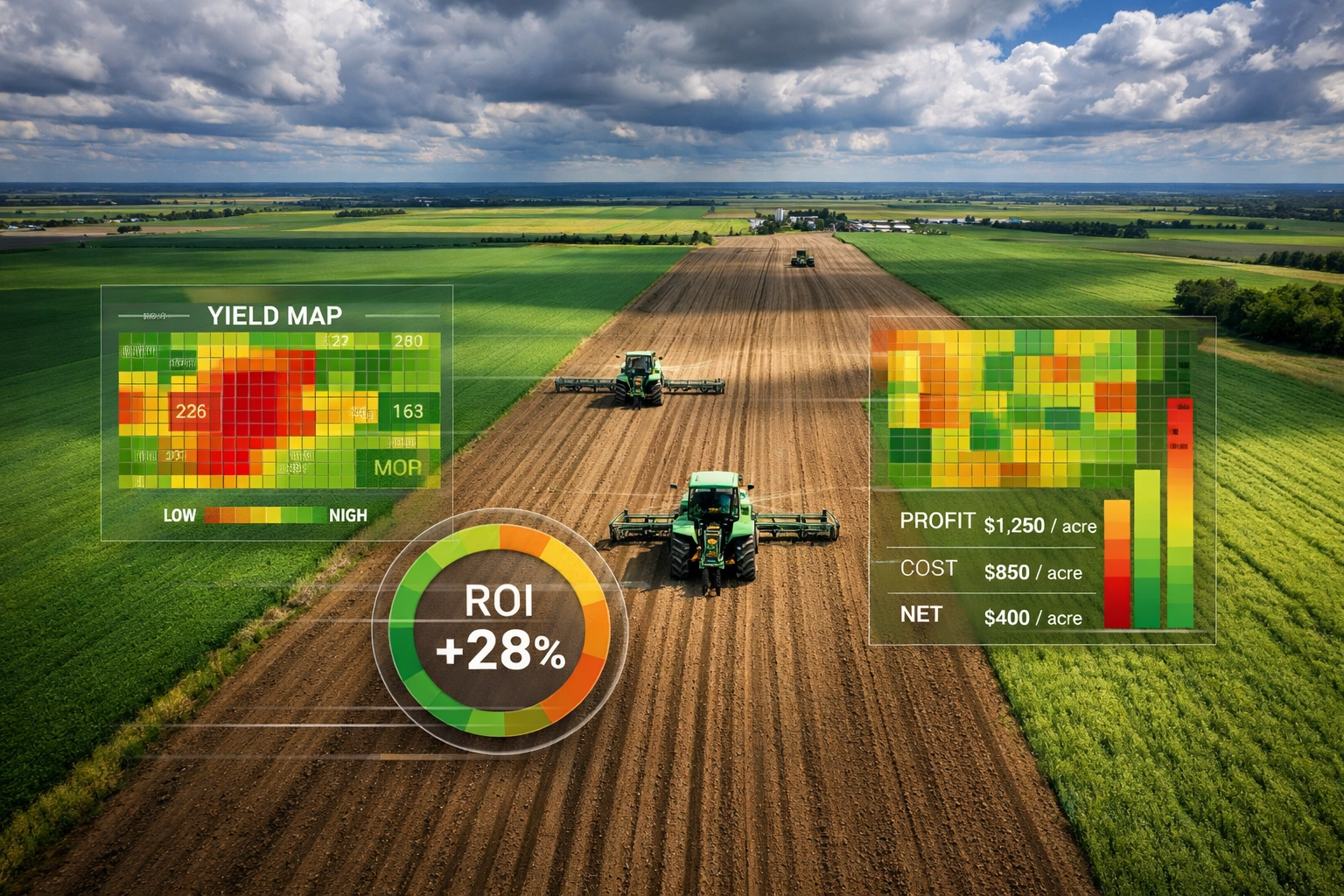
Your precision ag stack (GPS guidance, variable rate technology, yield monitors, soil sensors) represents $150,000-$500,000+ in capital deployment. Most operators track these as equipment expenses. Strategic finance demands full ROI attribution:
- Fuel savings from GPS guidance ($8-12/acre annually)
- Yield improvements from variable rate fertilization (3-7% increase)
- Input optimization from prescription maps ($15-25/acre savings)
- Labor efficiency gains (1.5-2x operator productivity)
- Data asset value for carbon program enrollment
When you build crop-specific, field-level ROI models for precision ag investments, decision-making transforms from “gut feel” to “engineered capital allocation.” PE-backed operations consistently outperform family-held farms precisely because they apply this financial discipline.

2. Equipment Capital Efficiency
The average North American farm now operates $750,000-$2.5M in equipment inventory. Strategic finance asks uncomfortable questions:
- What’s your actual equipment utilization rate vs. theoretical capacity?
- Are you over-capitalized in owned assets when custom hire or leasing generates better ROI?
- How does residual value deterioration compare to depreciation schedules?
- What’s the opportunity cost of capital tied up in equipment vs. land acquisition or technology deployment?
Data-driven equipment rationalization often unlocks $200,000-$500,000 in capital that can be redeployed to higher-return activities: without reducing operational capacity.
3. ESG and Carbon Credit Monetization
Carbon credit programs, conservation incentives, and ESG certifications represent emerging asset classes that most farms treat as revenue bonuses rather than strategic financial assets.
Elite operators with strategic finance infrastructure:
- Model carbon credit values as 10-15 year cash flow streams with basis risk and price volatility assumptions
- Build additionality and permanence into land use decisions and lease negotiations
- Structure crop rotation strategies to optimize both agronomic outcomes and carbon sequestration values
- Position ESG assets as exit value multipliers for PE liquidity events
This isn’t hypothetical: institutional capital is increasingly applying ESG premium valuations to farm operations with auditable sustainability metrics and monetized carbon positions.
How Can Data-Driven Finance Help Farms Secure Better Capital?
Lender relationships have fundamentally shifted. Farm Credit, regional banks, and institutional ag lenders aren’t just evaluating collateral and historical performance: they’re underwriting management sophistication and financial infrastructure quality.
Current market dynamics amplify this reality: with 10-15% of farmers in a “red zone” questioning business viability, lenders are intensely focused on credit quality differentiation. The operators who secure favorable terms, flexible covenants, and relationship-driven support are those who demonstrate institutional-grade financial management.
What Lenders Actually Want to See
Real-time financial dashboards showing:
- Rolling 13-week cash flow projections vs. actuals
- Field-level profitability by crop and rotation
- Working capital ratios and liquidity metrics
- Debt service coverage with scenario modeling
- Equipment utilization and capital efficiency metrics
Strategic plans with financial modeling that demonstrate:
- Multi-year expansion scenarios with capital requirements
- Input cost sensitivity analysis and hedging strategies
- Revenue diversification plans (carbon credits, renewable energy, value-added processing)
- Succession planning and enterprise continuity
Financial experts consistently emphasize that farmers heading into 2026 must start with comprehensive balance sheets and accurate asset-liability assessments rather than assumptions or guesses. This data-driven foundation enables dynamic plan adjustments as market conditions evolve: exactly what sophisticated lenders require to underwrite risk.
Key Takeaways
✓ Strategic finance is forward-looking and field-specific, unlike traditional backward-looking, farm-wide accounting
✓ Cash flow forecasting at weekly granularity is now mandatory given record operating loan sizes (30% higher than prior year) and working capital constraints affecting 57% of crop farmers
✓ Precision agriculture ROI modeling, equipment capital efficiency, and ESG asset monetization represent the three primary scaling levers for modern agribusiness
✓ 10-15% of farmers are questioning business viability in 2026; strategic finance infrastructure is the primary differentiator between distressed operations and those positioning for growth
✓ Lenders now underwrite management sophistication, not just collateral: data-driven financial dashboards and scenario modeling secure favorable capital terms
✓ 31% of farmers expecting larger 2026 operating loans cite carryover debt from prior years: a structural problem that requires strategic finance intervention, not more borrowing
The farms that thrive in 2026 won’t be the largest: they’ll be the best-financed.
If you’re operating a mid-to-large scale farming business, managing PE-backed agribusiness assets, or evaluating agricultural investments, the gap between strategic finance and traditional accounting represents your competitive advantage. The operators building field-level profitability models, engineering precision agriculture ROI, and monetizing ESG assets aren’t just surviving the current capital crunch: they’re positioning for the next decade’s consolidation wave.
At RampUp Growth Advisors, we build strategic finance infrastructure for capital-intensive operations navigating complex growth environments. Whether you need rolling cash flow models for lender negotiations, precision ag ROI frameworks, or financial positioning for PE liquidity events, we speak your language.
Let’s talk about turning your farm’s financial data into your most powerful growth engine. Reach out today.

Written by
Christian Liu
Related Articles

The 2026 Masterclass: Transforming Raw Data Into Your Most Powerful Strategic Asset
Every executive claims their organization is “data-driven.” Yet according to NewVantage Partners’ 2024 Big Data...

The Innovation Velocity Paradox: Why Capital Alone Won't Fund the Future in 2026
The venture capital playbook that minted unicorns from 2015 to 2021 is dead. Not dying....

Strategic Finance in Canadian Defence: The CEO’s Secret Weapon for Winning DND Contracts and Scaling Growth
Quick Summary Strategic finance is increasingly the differentiator in Canada’s defence procurement environment. For growth-stage...