
The 2026 Strategic Finance Playbook: Navigating a Technical Recession with Agentic Agility
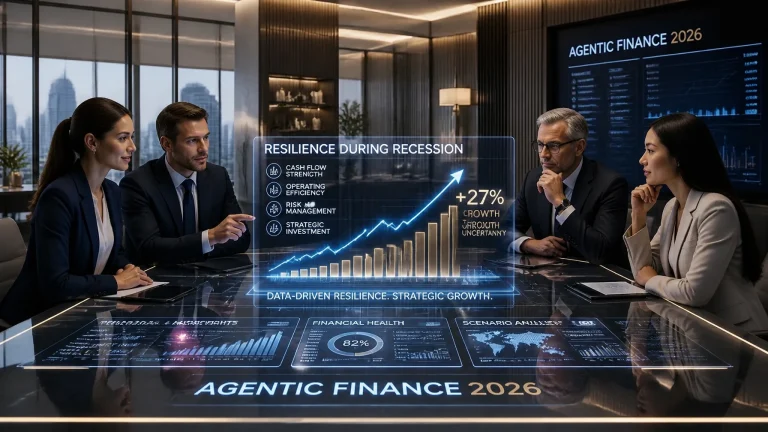
Entering June 2026, the global economic narrative is one of sharp contradictions. While the “Great Rebound” of late 2025 gave many businesses a second wind, we find ourselves currently navigating a “technical recession” (at least in Canada, the only G7 country to do so as of this writing): a period characterized by two consecutive quarters of marginal GDP contraction combined with persistent input volatility.
According to the JPMorgan 2026 Business Leaders Outlook, while 51% of middle-market executives remain optimistic about their own firm’s prospects, a cautious 27% of small businesses are bracing for further downturns. The difference between those thriving and those merely surviving isn’t just their cash reserve; it’s their Agentic Agility.
At RampUp Growth Advisors, we’ve seen that the traditional “wait and see” finance model is officially obsolete. To win in 2026, leadership teams must pivot from passive reporting to active, agentic management. This playbook outlines the strategic finance trends and management shifts required to turn economic headwinds into your competitive advantage.
1. The Rise of Agentic AI: From Insights to Action
For years, AI in finance was about “predictive” analytics: telling you what might happen. In 2026, the trend has shifted toward Agentic AI. As highlighted in Deloitte’s Finance Trends 2026, although 63% of finance teams have deployed AI, the leaders (the “strategy shapers”) are moving toward fully integrated AI agents.
Agentic AI doesn’t just build a dashboard; it orchestrates workflows. Imagine a system that detects a 2% dip in margin in a specific region and automatically triggers a dynamic pricing adjustment or renegotiates a supplier’s payment terms within pre-set policy boundaries.
Why it matters now:
In a technical recession, the speed of response is the primary determinant of margin protection. By the time a human CFO reviews a monthly report, the leakage has already occurred. Agentic agility allows for real-time course correction.

2. Strategic Cost Management: The “Cut to Invest” Mandate
The old recession playbook was simple: slash SG&A by 15% and freeze hiring. In 2026, that approach is considered “blunt force trauma” that kills future growth. KPMG’s 2026 CFO reports suggest a move toward Structural Cost Transformation.
Instead of cutting marketing or R&D: the very engines of your recovery: modern strategic finance focuses on:
- Zero-Based Budgeting (ZBB) 2.0: Rethinking every dollar through the lens of AI-enabled productivity.
- Technical Debt Retirement: Eliminating legacy systems that cost more to maintain than they provide in value.
- Talent Reskilling: Shifting spend from “transactional roles” to “strategic architects” who can manage the new agentic systems.
The goal isn’t just a leaner P&L; it’s a more efficient engine. At RampUp, we help clients implement Zero-Based Budgeting to ensure every resource is mapped to a growth outcome.
3. M&A as a Lever for Volatility
While capital remains expensive due to persistent interest rate floors, 2026 is seeing a surge in “Offensive M&A.” As weaker competitors struggle with debt service and declining demand, well-capitalized firms are using the downturn to acquire market share, talent, and proprietary technology.
The JPMorgan Business Leaders Outlook notes that nearly 80% of respondents expect revenue growth this year despite the macro climate. Much of this growth is expected to come from strategic acquisitions that consolidate fragmented markets.

4. Comparing the Eras: Finance Transformation 2026
To understand the shift, we must look at how the core functions of finance have evolved over the last 24 months.
| Feature | Traditional Finance (2023-2024) | 2026 Strategic Finance |
|---|---|---|
| Forecasting | Monthly/Quarterly cycles | Real-time, continuous agentic forecasting |
| Data Focus | Historical P&L reporting | Forward-looking scenario modeling |
| Cost Strategy | “Across the board” percentage cuts | Strategic “Cut to Invest” structural shifts |
| AI Usage | Generative (Chatbots, Summaries) | Agentic (Autonomous workflow orchestration) |
| Role of CFO | Scorekeeper and Risk Mitigator | Strategic Value Architect |
5. The Recession Readiness Checklist
Navigating a technical recession requires a disciplined approach to liquidity and operations. Use the following checklist to evaluate your firm’s current standing.
| Category | Action Item | Status |
|---|---|---|
| Liquidity | Stress-test cash flow for a 15% revenue drop over 3 quarters. | [ ] |
| Agentic Tech | Implement AI agents for working capital and expense management. | [ ] |
| Contractual | Renegotiate vendor contracts with “recession-flexible” clauses. | [ ] |
| Portfolio | Conduct a “Pruning Analysis” on sub-scale or unprofitable product lines. | [ ] |
| Visibility | Ensure real-time performance visibility is available to all key stakeholders. | [ ] |

Conclusion: The Path Forward
The technical recession of 2026 is not a signal to retreat; it is a signal to refine. Businesses that embrace Agentic Agility (the combination of autonomous AI insights and strategic, high-level human judgment) will emerge from this period not just intact, but dominant.
As KPMG notes, the CFO of 2026 must be a “Strategic Value Architect.” This means moving beyond the numbers to shape the very fabric of enterprise strategy. Whether you are a venture-backed startup or a Fortune 1000 leader, the roadmap is the same: protect your cash, automate your insights, and invest in the future while others are frozen by the present.
Does your finance function have the agility to survive 2026?
At RampUp Growth Advisors, we specialize in transforming traditional finance departments into high-velocity strategic engines. From financial modeling for fundraising to modernizing your CFO playbook, our team of experts is ready to help you navigate this volatility and unlock your company’s full potential.
Reach out to RampUp Growth Advisors today for a confidential strategy session and let’s build your 2026 growth engine together.

Written by
Christian Liu
Related Articles

The $2M Mirage: How to Rescue Your Cash Flow from the AR/AP Trap
It was 2:00 AM on a Tuesday, and Alex, the CEO of a rapidly scaling...

Stop Waiting for Day 10: The Shift from Monthly Close to Real-Time Visibility
Most founders are driving at 100 mph while looking exclusively in the rearview mirror. In...

The Ivy League of Innovation: Transforming Universities into High-Velocity Startup Hubs in 2026
The next unicorn isn’t being built in a garage. It’s being built in a dorm...