
Theory Meets Reality: Leading the Next Generation of International Finance at Carleton University
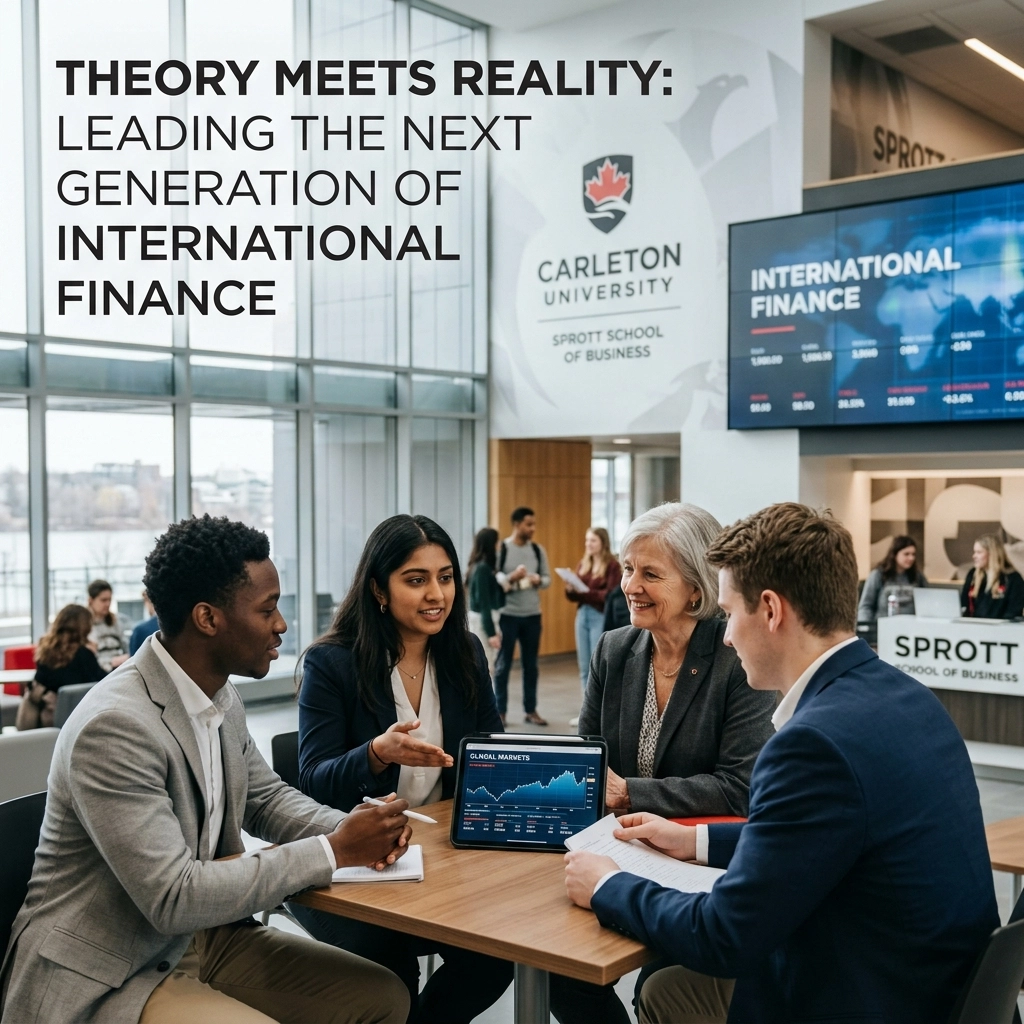
Walking through the doors of the Nicol Building at Carleton University this past Winter Term, I felt a familiar rush of adrenaline. It’s the same feeling I get before a high-stakes board meeting or a complex capital-raising round. But this time, the "boardroom" was filled with the bright, ambitious minds of the Sprott School of Business, and the agenda was International Finance in the year 2026.
As the Founder and CEO of RampUp Growth Advisors, my day job involves helping companies scale, optimize, and navigate the choppy waters of global markets. But stepping into the role of an instructor for an international finance course allowed me to see the industry through a different lens. It wasn’t just about teaching foreign exchange markets or international parity conditions; it was about bridging the massive chasm between academic theory and the "we-need-to-fix-this-by-Monday" reality of modern business.
The world of 2026 is vastly different from the one we knew just a few years ago. Global trade shifts, AI-integrated decision-making, and shifting geopolitical alliances like the CUSMA reviews have turned the traditional MNE (Multinational Enterprise) playbook into a living document that requires constant editing.
Beyond the Textbook: The Shift to Strategic Finance
In the classroom, we cover the fundamentals. We talk about cash flow management and how currency quotation methods affect the bottom line. But the most important lesson I wanted my students to take away is that Strategic Finance is the engine of the modern MNE.
For a long time, finance was seen as a "rear-view mirror" function. You looked at what happened last month, reconciled the books, and moved on. In 2026, if you’re looking in the rear-view mirror, you’ve already crashed. Strategic finance is forward-looking. It’s about data-driven decision-making that anticipates market volatility rather than just reacting to it.
One of the first real "aha" moments landed when we were working through a pretty standard hedging example. A student stopped mid-discussion and basically said, "So… international finance in 2026 isn’t really about hedging for hedging’s sake, is it?" Exactly. That was the unlock. It’s not just about protecting against currency swings anymore. It’s about Decision Velocity: how fast management can see risk, process signal, and act before the window closes. And increasingly, it’s about using AI as a strategic cockpit, not a shiny dashboard toy bolted on after the fact.
I told my students: "Accounting keeps you out of jail, but Strategic Finance keeps you in business." That line got a laugh, but it also stuck. When we discussed capital budgeting for international projects, we weren't just running numbers through a formula. We were debating the real-world implications of political risk in emerging markets, supply chain fragility, and how to hedge against uncertainty that doesn’t show up neatly on a standard spreadsheet. You could almost see the lightbulbs flick on row by row: this wasn’t a theory course pretending to be practical; this was practical reality wearing a theory nametag.

Why Ottawa is the New Global Finance Hub
There’s a common misconception that if you want to play in the big leagues of international finance, you have to be in New York, London, or maybe Toronto. But teaching at Carleton’s Sprott School of Business reinforced my belief that Ottawa is quietly becoming a powerhouse for global business talent.
Ottawa has a unique ecosystem. We have the policy-making heartbeat of the federal government, a thriving tech sector (both in Kanata and downtown), and a growing community of consulting experts. The students I met at Sprott aren’t just looking for local jobs; they are thinking about how to position Canadian firms in a global marketplace.
The biggest lightbulb moment in this part of the course came during a debate about Ottawa’s local tech ecosystem. We were talking about the MindBridge AI challenge and the broader analytics talent developing here, and at first a few students treated it like a nice local story: interesting, but not exactly global. Then the room turned. Fast. The class started connecting the dots between Ottawa’s AI depth, policy proximity, and cross-border business literacy. Suddenly the takeaway was obvious: this city gives them a massive advantage in the global MNE sphere. Not despite being in Ottawa. Because they’re in Ottawa.
That was a fun mentor moment for me. You could see the shift from "we’re competing from Canada" to "we’re competing with assets most global teams would love to have." The caliber of talent coming out of Carleton is fueling this shift. These students are digital natives who understand that a company’s financial health is inextricably linked to its technological edge. They are the ones who will be leading the next wave of international enterprises, and they are doing it from right here in the capital.
Insights from the Classroom: AI and the CUSMA Review
One of the highlights of the term was seeing how students engaged with modern challenges. We didn't just stick to the syllabus; we looked at what was happening in the news and the local tech scene.
1. AI-Enabled Financial Decision-Making
We spent a significant amount of time discussing the role of AI in finance. Some of my students were following the MindBridge Data Science Challenge, a local Ottawa initiative that pushes the boundaries of how we use data to detect anomalies and drive financial clarity. In 2026, AI isn't a "bonus feature": it’s the baseline. But one of the sharper classroom realizations was that AI’s real value isn’t just prediction accuracy. It’s operating rhythm. It shortens the gap between signal and decision. In other words, it increases Decision Velocity. That’s why I kept pushing the idea of AI as a strategic cockpit: helping leadership teams navigate in real time, not just admire historical data with prettier charts.
2. The 2026 CUSMA Reviews
With the scheduled six-year review of the Canada-United States-Mexico Agreement (CUSMA) hitting the headlines, our classroom debates got heated. Students were analyzing and presenting how shifts in trade policy could disrupt supply chains and necessitate a complete overhaul of international budgeting strategies. It was a perfect example of how "Strategic Finance" involves understanding law, politics, and economics all at once. One class exchange really stayed with me: a student connected CUSMA risk, FX exposure, and AI-driven scenario planning in one answer and then shrugged like it was obvious. That’s when I knew the material had clicked. Not textbook smart. Boardroom useful.

The Theory-Reality Gap: Why You Need a Partner
As much as I love teaching, I know that the real world doesn't give you a rubric or a syllabus. In business, the "exam" happens every day, and the stakes are much higher than a grade. This is where the value of a strategic finance partner becomes crystal clear.
Many MNEs struggle because they have great products but lack the financial infrastructure to scale internationally. They might have a team of accountants, but they don't have a CFO-level strategist looking at the global landscape.
At RampUp Growth Advisors, we act as that bridge. We take the high-level theories, the same ones I teach at Carleton, and apply them to the specific challenges of your business. Whether it’s capital raising, navigating a market downturn, or optimizing your data strategy, we bring a mentor’s perspective and an executive’s execution.
Mentorship and the Future of Growth
Teaching at Sprott reminded me that mentorship is a two-way street. While I was teaching these students about the intricacies of international finance, they were reminding me of the importance of curiosity and agility. They don't take "that's just how it's done" for an answer. They want to know why and how it can be done better.
That’s the same spirit we bring to our clients at RampUp. We don't just provide reports; we provide coaching and mentorship to help founders and CEOs become more financially literate and strategically minded. We want you to understand your numbers so well that you can lead your company into any market with total confidence.

Final Thoughts: Class is Never Out
As the Winter Term 2026 comes to a close, I’m headed back to the RampUp office with a renewed sense of excitement. The next generation of finance leaders is ready, and the tools available to us, from AI to advanced global trade platforms, have never been more powerful.
But remember – having the tools is only half the battle. You need the strategy to use them. Whether you’re a multinational enterprise or a growing startup in Ottawa looking to go global, don’t try to navigate these complexities alone.
If you’re ready to move beyond the balance sheet and start using finance as a strategic weapon for growth, let’s talk. At RampUp Growth Advisors, we’re here to help you turn theory into reality.
Ready to ramp up your international strategy? Contact us today and let’s build your roadmap to global success.

Christian Liu is the Founder & CEO of RampUp Growth Advisors and an occasional Contract Instructor at Carleton University’s Sprott School of Business. He specializes in helping companies bridge the gap between where they are and where they want to be through strategic finance and expert consulting.