
What Canada’s World Cup Victory Teaches Us About Weathering the 2026 Recession
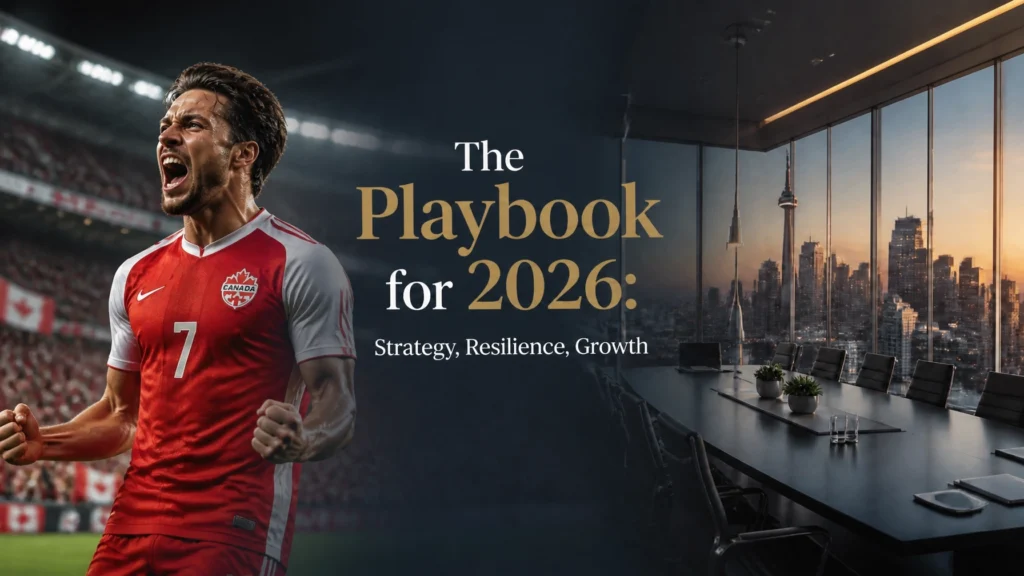
On June 18, 2026, BC Place delivered one of those rare moments when sport and national confidence felt completely aligned. When the final whistle blew on Canada’s 6-0 demolition of Qatar, the roar of 52,497 fans wasn't just a celebration of a game; it was the sound of a country realizing it belonged on the world stage.
Between Jonathan David’s masterclass hat trick and Nathan Saliba’s clinical free kick, there was a sense of absolute control. For ninety minutes, the outside world's problem with the headlines about the "technical recession," the sluggish 1.1% GDP growth, and the CUSMA tariff debates faded into the background.
That contrast is hard to ignore, especially when a team operating with clarity, discipline, and conviction while much of the business community is navigating uncertainty.
Canada’s Men’s National Team entered its final Group B match with four points after that gritty 1-1 draw against Bosnia at BMO Field. They had faced adversity, including Ismaël Koné’s recent injury, yet stayed disciplined. They were playing with a "win-the-group" mindset while most of the country was bracing for a "survive-the-quarter" reality.
That setup made the result against Switzerland even more instructive. Canada needed only a draw to top Group B, but a 2-1 defeat to Switzerland pushed them into second place in the group. Even so, they still advanced to the knockout rounds, a reminder that strong teams are not defined by avoiding setbacks, but by absorbing them and adjusting quickly.
There are six powerful lessons here for every founder, CEO, and investor navigating Canada's current economic climate.
If a business were on the pitch today, would it be standing tall or scrambling? Here’s the playbook.
1. Set Pieces Matter: The Power of Strategic Planning
Nathan Saliba’s free-kick goal wasn't a fluke. It was a "set piece": a pre-planned, highly choreographed play executed with precision when the ball is dead.
In a recession, the "ball is dead" more often than we’d like. Deals stall, capital expenditures are delayed (down 0.2% annualized this quarter), and markets move sideways. This is where most businesses fail: they try to improvise.
Strategic management isn't about what you do when things are moving fast; it’s about the plays you’ve practiced for when things stop. At Ramp Up Growth Advisors, we call this the "Growth Blueprint." Just as Saliba knew exactly where that ball was going before he hit it, you need a financial model that tells you exactly where your cash is going before the quarter even starts.
What’s your play? Do you have a "set piece" for a 10% revenue dip, or are you just hoping for the best?

2. Depth of the Bench: Your Strategic Partners
When Ismaël Koné went down, the air left the stadium for a moment. But then Cyle Larin came off the bench against Bosnia and clinically buried the equalizer. That is "Bench Depth."
In a recession, your "bench" isn't just your employees; it’s your ecosystem of partners. Many Canadian firms are currently delaying hiring, but the winners are doing the opposite: they are bringing in high-level expertise on a fractional or consulting basis to fill the gaps.
If your "starter" (your internal CFO or lead strategist) is overwhelmed by the complexity of today’s strategic finance landscape, who is your Cyle Larin? Having a trusted partner to step in and stabilize the game is the difference between a loss and a draw that feels like a win.
3. Possession Under Pressure: Cash & Liquidity Management
Canada held 77% possession against Qatar. They had 97 touches in the opposition's penalty area: a record since 1966. They weren't just playing; they were controlling the tempo.
In business, Cash is your Possession stat.
When the S&P/TSX dropped 9% earlier this year, the companies that panicked and sold off assets lost their "possession." The companies that maintained a strong liquidity position were able to dictate the terms of their recovery.
| Statistic | World Cup Parallel | Business Translation |
|---|---|---|
| Possession % | 77% vs Qatar | Cash Runway / Liquidity |
| Penalty Area Touches | 97 (Record) | Market Share Engagement |
| Successful Passes | High-Volume Accuracy | Operational Efficiency |
| The Result | Total Control | Sustainable Growth |
In a recession, don't just play defense. Maintain possession of your cash flow. If you lose control of the ball, you’re just chasing the game.
4. The Comeback Mindset: Resilience and Re-underwriting
Down 1-0 to Bosnia at BMO Field, Canada didn’t collapse. They hit the woodwork, they pushed the pace, and they eventually forced the error. They re-evaluated their tactics mid-game.
We call this "Re-underwriting the Strategy."
Many businesses are still running on a 2024 or 2025 playbook. But the 2026 reality is different. We have CUSMA tariff uncertainty and a technical recession. If you are still trying to score using last year's tactics, you’re going to get caught offside.
Resilience isn't just "toughing it out." It’s having the humility to look at your business model, admit where it’s failing in the current climate, and adjusting the formation.
A fair question for leadership teams is this. Have growth targets changed in the last six months, or is the original plan still being pursued despite the shift in conditions?
5. Playing at Home: The Canadian Advantage
There is something powerful about 43,002 people at BMO Field singing "O Canada." Home-field advantage is real, but it is not absolute.
Canada’s 2-1 loss to Switzerland is a useful reminder that even favorable conditions and clear expectations do not guarantee the desired outcome. In business, that matters. Market familiarity, local incentives, and customer proximity can create an edge, but leadership teams still need contingency plans for the moment when momentum shifts and the expected result does not arrive. The advantage is valuable; adaptability is essential.
For Canadian business owners, "Home Field" means leveraging the specific tools available in this 2026 climate. While the global outlook is murky, we have:
- SR&ED Enhancements: The recent federal boost to R&D credits.
- Productivity Super-Deduction: A critical tool for those investing in AI and automation.
- Energy Sector Strength: A literal powerhouse for the TSX.
Companies that lean into these local incentives, rather than just looking at the broad "recession" headline, are the ones finding the 1.3% growth that the rest of the market is missing.
6. Trusting the Playbook: Why You Need a Coach
The coaching staff for the Men's National Team remained calm during the Bosnia draw. They trusted the system. They didn't make emotional, reactive substitutions.
In business, growth often stalls because leaders make emotional decisions during a downturn. They cut marketing when they should be doubling down, or they freeze investment just as a competitor is most vulnerable.
This is where a trusted strategic partner comes in. At Ramp Up Growth Advisors, we act as the coaching staff for your finance and operations. We bring the data, the Fortune 500 experience, and the objective "eye from the sidelines" to ensure you aren't just running: you're moving toward the goal.

The Final Whistle (For Now)
Canada’s 2-1 loss to Switzerland changed the standings, but it did not end the campaign. A draw would have been enough to top Group B. Instead, Canada finished second and still moved on to the knockout rounds. That is a practical lesson for business leaders that not every quarter goes to plan, not every advantage holds, and not every setback is fatal.
The recession is still the opponent. Tariff uncertainty is still the opposing goalkeeper. The objective is not to assume the expected outcome will arrive; it is to build an organization that can respond when it doesn’t.
But with 77% possession of your strategy, a deep bench of partners, and a clinical approach to your "set pieces," a business is better positioned not only to weather the recession, but to recover quickly when conditions shift.
The better question for most organizations is whether they are built only for the ideal scenario or whether they can adapt when the match turns against them. The strongest teams are usually the ones investing deliberately in strategy, liquidity, and bench strength before the pressure peaks.
If your organization is looking for a partner to help re-underwrite growth strategy or navigate the complexities of strategic finance in 2026, Ramp Up Growth Advisors can help. The game is far from over, but the right playbook matters.
About RampUp Growth Advisors
We provide premium consulting services focused on transformational business growth. With a proven track record spanning over two decades, we specialize in delivering strategic solutions that drive exceptional success for Founders, PE-backed firms, and Fortune 1000 leaders.
Explore our Services | Meet the Team